Entradas

Mostrando las entradas etiquetadas como Religious Festivities

Holy Week in Patzcuaro: Captivating Ancestral Traditions

Imagen
Holy Week in Patzcuaro ,  Michoacan , dates back to colonial times, in the 16th century, when the Franciscan friars carried out the evangelization. Holly Week in Pátzcuaro, Michoacan, Mexico Holy Week is a time when the entire Lake District experiences an atmosphere of heightened religious fervor and mysticism. This tradition has endured over time, captivating locals and strangers, becoming a magnet for those seeking to live a unique religious experience in a magical environment. Among the traditions that remain in  Pátzcuaro  and that, in our case in Mansión Iturbe , have been carried out since it was the house of the family of Doña Francisca de Iturbe y Anciola , our beloved and remembered Doña Paca , we find the Altar of Dolores  (“Altar of Pain”), which is a symbol of mourning and pain for the crucifixion of Jesus. Altar de Dolores at Mansion Iturbe in Pátzcuaro, Michoacan, México You will also find different variati...

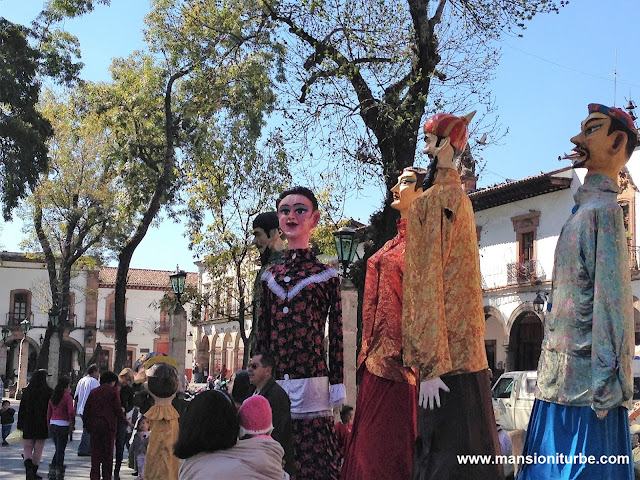
Mojigangas - a Real Pátzcuaro Tradition

Imagen
  The  “mojigangas”  are one of the most significant traditions of Pátzcuaro . Every year, before the feast of the Virgin of Health of Pátzcuaro , which is on December 8, the famous mojigangas “walk around” different areas of Pátzcuaro, “dancing” in an atmosphere of joy among those who happen to come across them. If you visit Pátzcuaro between November 8 and December 8 , you are likely to find the mojigangas, during their "dancing tours" of  Pátzcuaro , moving to the lively music that accompanies them, collecting money to pay for the band music as they dance. Mojigangas a real Pázcuaro Tradition The size of the mojigangas is their distinguishing characteristic:  They can reach up to four meters tall, like giant puppets.  Fortunately for the puppeteers, who are hidden inside the puppets’ garments and do the “walking” and “dancing,” the. Mojigangas y are made of card...

Festivity of Pátzcuaro’s Lady of Health

Imagen
The month of December arrives and in Pátzcuaro we automatically think of the Festivity of Our Lady of Health in Pátzcuaro .  This emotional festivity takes place annually, when the faithful come to the Basilica in Pátzcuaro , and offer their prayers to Our Lady of Health. As a preamble to this festivity, from a month before the actual day of festivities (December 8) we begin to see in the streets of Pátzcuaro the famous  Mojigangas  (20-foot-tall “dolls”) dancing happily (men moving from the bases of the “dolls”)  to the sound of Michoacán music, giving a touch of joy to the streets of our Magical Town. Mojiganas in Patzcuaro, Michoacán Traditionally, these huge creatures are seen on Sundays, so if you have the opportunity to visit Pátzcuaro , in the month before the celebration of Our Lady of Health of Health, you could probably chance upon them, at times dancing through streets near downtown.  Another place where you might find them is in the Plaza Vasco...

Mojigangas in Patzcuaro

Imagen
The Mojigangas (mo-hee-GAHN-gahs) proclaim the proximity of the celebration of Our Lady of Health in Patzcuaro. We see these giants in the streets of our magical village during the month of November on weekends. Sunday is the day that traditionally they come out to dance in the streets, but the most important date is December 8 , when we celebrate the coronation of the Virgin. Mojigangas in Pátzcuaro, Michocán The tradition of the Mojigangas has persisted for generations; they are yet another example of the vast and rich culture of Pátzcuaro . Mojigangas in Pátzcuaro, Michoacán These giants arrived in Mexico (then “New Spain”) from Spain in the 16 th  Century (known as Spain’s “Golden Century”), when Spain was renowned for its advances in the arts, music, and literature. The name is believed to have originated from Bojiganga or Boxiganga, which were small street theater groups who produced humorous plays.     Mojigangas appeared in Mexic...